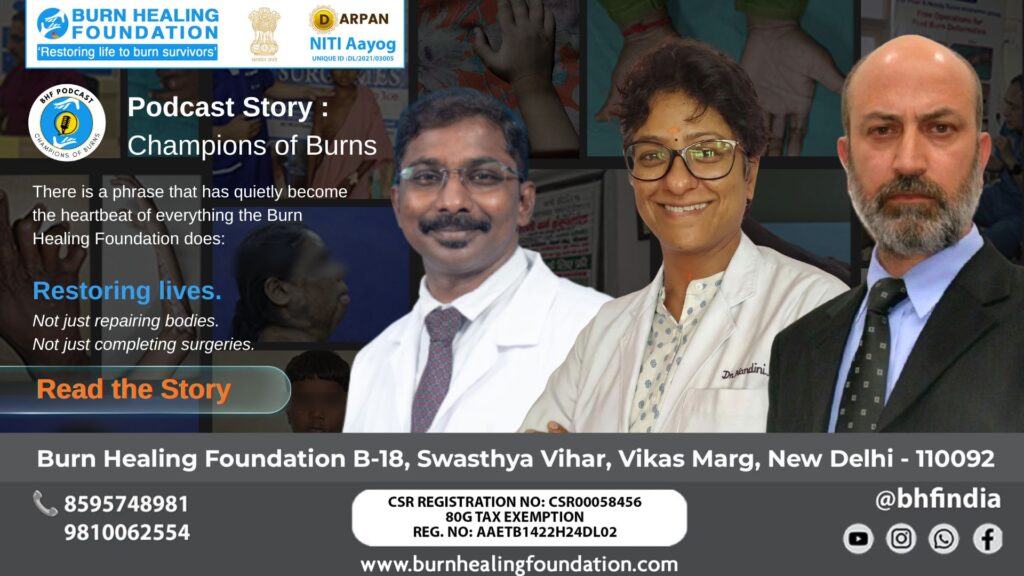
There is a phrase that has quietly become thWhen Healing Becomes a MovementThe Story Behind Champions of Burns
There is a phrase that has quietly become the heartbeat of everything the Burn Healing Foundation does: restoring lives. Not just repairing bodies. Not just completing surgeries.
Restoring lives — in the fullest, most human sense of those two words.
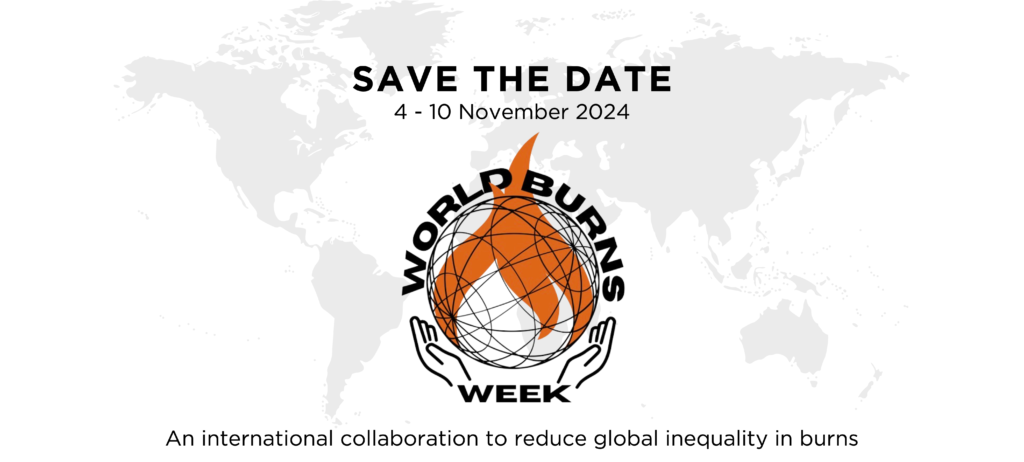
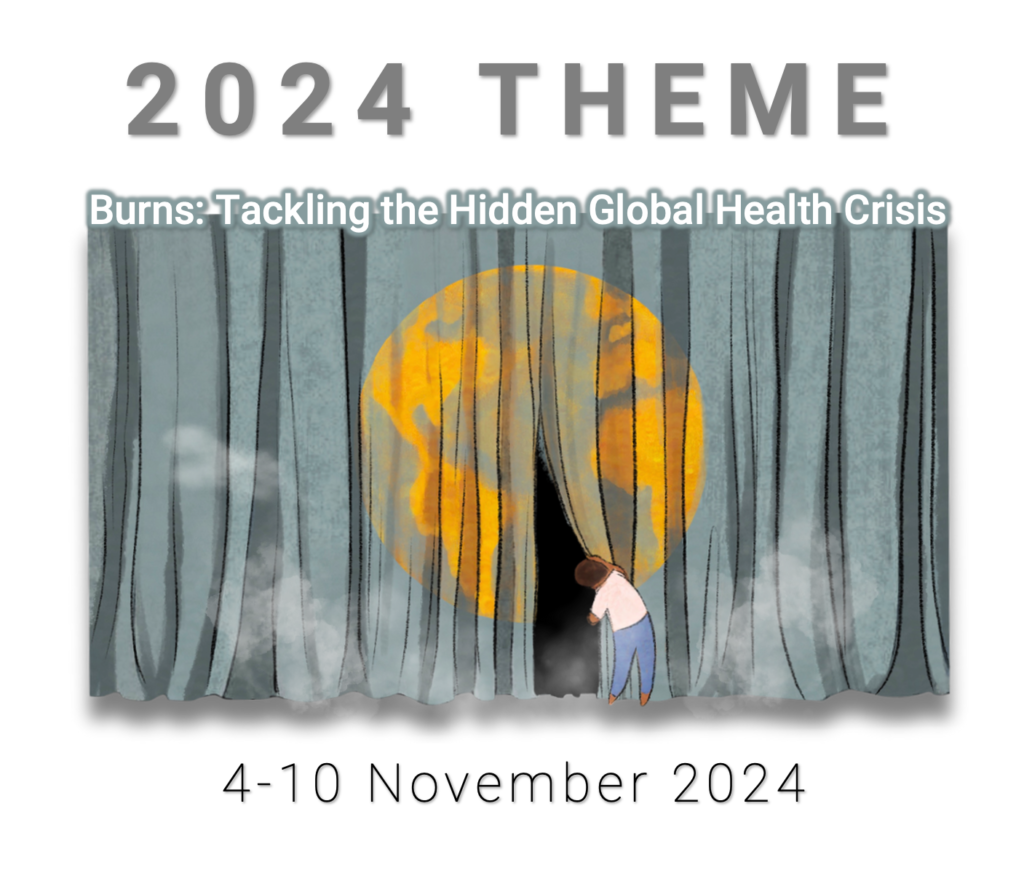
Champions of Burns, BHF’s podcast series, launched in alignment with World Burns Week 2025, is where that philosophy is given a voice. And three episodes in, it is already telling a story that goes far deeper than medicine.More Than a Podcast
When BHF set out to create Champions of Burns, the goal was never to produce content. It was to build a movement — one conversation at a time. Each episode brings together a surgeon from the BHF partner hospital network and a guest clinician in a recorded conversation that asks not just what they do but why they do it, what it costs them, and what it gives back.
The result is something rare in the world of healthcare communication: a series where the human being always comes before the case file.
As the National Association of Burns India hosts its annual conference from 27th February to 1st March 2026, our podcast series extends the perspectives of our Chairperson and the doctors from our network hospital, who are participating in closed-door scientific discussions to find better ways to treat the community.Episode 1: Dignity Is the Real Diagnosis
The series opened with Dr Viswa Chaitanya in conversation with Dr Selva Seetharaman, a plastic and reconstructive surgeon working through the Grace Kenneth Foundation Hospital in Madurai and Prime & Edison Hospital in Chennai.
The theme that emerged was deceptively simple, and yet quietly radical: recovery is about reclaiming dignity.
We tend to measure burn care success in clinical terms—successful grafts, reduced contractures, improved range of motion. But Dr SeethaRaman pushed the conversation into a more uncomfortable, more honest place. What does it mean to truly heal? It means being able to look at yourself in a mirror again. It means walking back into a room without bracing yourself. It means the world around you no longer treats your injury as the most important thing about you.
Burn survivors, he reminded us, are not simply patients. They are teachers. Their resilience — the kind forged by something most of us will never experience — is itself a clinical resource, if surgeons are willing to learn from it.Episode 2: Surgery Is the Beginning, Not the End
Episode 2 brought Dr Nandini Ramaswamy into the conversation, and she arrived with a philosophy that has since become one of the series’ most quoted lines: healing doesn’t end with surgery — it begins there.
Her message was both urgent and uncomfortable. The first year after a burn injury is the most critical window for intervention — and it is also the most routinely neglected. When acute care fails, survivors develop contractures that lock joints, restrict movement, and can define the rest of their lives. These are not inevitable outcomes. They are system failures.
But Dr Ramaswamy also brought something unexpected: wonder. She spoke about patients who, without any formal medical training, had fashioned their own pressure garments, improvised splints, and devised rehabilitation routines — because they had to. Because no one else was going to. Survivors, she said, become innovators in their own recovery. And the least we can do is pay attention.
She was also unequivocal about the psychological dimension of burn injury, which the medical system chronically underestimates. The physical scars may be visible. But it is the invisible ones — the anxiety, the shame, the social withdrawal — that often cause the most lasting damage. Positive human connection, she argued, is one of the most powerful clinical tools we have. It just doesn’t come with a billing code.Episode 3: Courage in the Valley
If the first two episodes expanded what healing means, Episode 3 expanded where it happens.
Dr P. Umar Farooq Baba is an Additional Professor of Plastic and Reconstructive Surgery at SKIMS Srinagar — a hospital serving the Kashmir Valley, one of India’s most complex healthcare landscapes. With over 71 published research papers, editorial roles at PRS Global Open and the Journal of Medical Sciences, and leadership positions across APSI, ISSH, and NABI, Dr Baba represents something the series had not yet fully voiced: the surgeon as scholar, as humanitarian, as someone who chooses to stay and build where others might not.
Burn care in a conflict-affected region demands a different kind of courage. It is not just the surgery that is hard. It is the context surrounding it — the infrastructure gaps, the psychological weight carried by both patient and clinician, the relentless demand in a setting that never quite stops being in crisis. Dr Baba’s work is a reminder that the BHF network is not just a clinical partnership. It is a moral one.
His episode also underscored an important point about research: when it is conducted in underserved settings by clinicians embedded in those communities, it does not stay in journals. It comes back to the patients who inspired it.What Three Episodes Have Already Taught Us
Across these first three conversations, a clear and coherent vision has emerged—one that goes beyond anything a mission statement alone could capture. Here are the six things Champions of Burns has already taught us:
- Surgery is the entry point, not the destination.
Burn care does not end when the patient leaves the operating theatre. Rehabilitation, psychological support, and community reintegration are not extras—they are the work. As Dr Nandini Ramaswamy put it plainly: “Healing doesn’t end with surgery — it begins there.” - Survivors are the greatest teachers in the room.
Every episode has surfaced the same truth: burn survivors carry knowledge, resilience, and adaptive genius that the medical system has barely begun to acknowledge. “Recovery is about reclaiming dignity”, — and nobody understands what that means more deeply than the people who have had to fight for it. - The invisible wounds run deepest.
Psychological trauma is often more disabling than physical injury — yet it receives a fraction of the attention and resources. The Champions of Burns series puts this on record, repeatedly and unapologetically. Positive human connection, it turns out, is one of the most powerful clinical tools available. - Research conducted in the hardest places matters most.
Dr Baba’s 71+ publications are not credentials on a wall — they are evidence built in one of India’s most challenging healthcare settings, designed to come back to the very patients who inspired them. “This is more than medicine. This is resilience in action.” - A network is only as powerful as its geographic reach.
BHF’s partner hospitals now span from Tamil Nadu and Chennai to Imphal in the northeast to Srinagar in the far north. That is not incidental. It is the mission made visible — burn care reaching the people who need it most, wherever they are. - Collective voice changes what is possible.
No individual surgeon, however gifted, can shift a system alone. What BHF has built — and what Champions of Burns is making audible — is a community of practice with a shared conscience.
Together, these voices are building not just a network, but a movement.
BHF’s Champions of Burns is not a podcast about what the foundation does. It is a podcast about why it matters. And with each episode, that answer grows richer, more urgent, and more human.
To support the Burn Healing Foundation’s work restoring lives across India, visit burnhealingfoundation.com or follow @bhfindia on Instagram, Facebook, and LinkedIn. Every donation funds a surgery. Every share amplifies a voice.
e heartbeat of everything the Burn Healing Foundation does: restoring lives. Not just repairing bodies. Not just completing surgeries.
Restoring lives — in the fullest, most human sense of those two words.
Champions of Burns, BHF’s podcast series, launched in alignment with World Burns Week 2025, is where that philosophy is given a voice. And three episodes in, it is already telling a story that goes far deeper than medicine.
More Than a Podcast
When BHF set out to create Champions of Burns, the goal was never to produce content. It was to build a movement — one conversation at a time. Each episode brings together a surgeon from the BHF partner hospital network and a guest clinician in a recorded conversation that asks not just what they do but why they do it, what it costs them, and what it gives back.
The result is something rare in the world of healthcare communication: a series where the human being always comes before the case file.
As the National Association of Burns India hosts its annual conference from 27th February to 1st March 2026, our podcast series extends the perspectives of our Chairperson and the doctors from our network hospital, who are participating in closed-door scientific discussions to find better ways to treat the community.
Episode 1: Dignity Is the Real Diagnosis
The series opened with Dr Viswa Chaitanya in conversation with Dr Selva Seetharaman, a plastic and reconstructive surgeon working through the Grace Kenneth Foundation Hospital in Madurai and Prime & Edison Hospital in Chennai.
The theme that emerged was deceptively simple, and yet quietly radical: recovery is about reclaiming dignity.
We tend to measure burn care success in clinical terms—successful grafts, reduced contractures, improved range of motion. But Dr SeethaRaman pushed the conversation into a more uncomfortable, more honest place. What does it mean to truly heal? It means being able to look at yourself in a mirror again. It means walking back into a room without bracing yourself. It means the world around you no longer treats your injury as the most important thing about you.
Burn survivors, he reminded us, are not simply patients. They are teachers. Their resilience — the kind forged by something most of us will never experience — is itself a clinical resource, if surgeons are willing to learn from it.
Episode 2: Surgery Is the Beginning, Not the End
Episode 2 brought Dr Nandini Ramaswamy into the conversation, and she arrived with a philosophy that has since become one of the series’ most quoted lines: healing doesn’t end with surgery — it begins there.
Her message was both urgent and uncomfortable. The first year after a burn injury is the most critical window for intervention — and it is also the most routinely neglected. When acute care fails, survivors develop contractures that lock joints, restrict movement, and can define the rest of their lives. These are not inevitable outcomes. They are system failures.
But Dr Ramaswamy also brought something unexpected: wonder. She spoke about patients who, without any formal medical training, had fashioned their own pressure garments, improvised splints, and devised rehabilitation routines — because they had to. Because no one else was going to. Survivors, she said, become innovators in their own recovery. And the least we can do is pay attention.
She was also unequivocal about the psychological dimension of burn injury, which the medical system chronically underestimates. The physical scars may be visible. But it is the invisible ones — the anxiety, the shame, the social withdrawal — that often cause the most lasting damage. Positive human connection, she argued, is one of the most powerful clinical tools we have. It just doesn’t come with a billing code.
Episode 3: Courage in the Valley
If the first two episodes expanded what healing means, Episode 3 expanded where it happens.
Dr P. Umar Farooq Baba is an Additional Professor of Plastic and Reconstructive Surgery at SKIMS Srinagar — a hospital serving the Kashmir Valley, one of India’s most complex healthcare landscapes. With over 71 published research papers, editorial roles at PRS Global Open and the Journal of Medical Sciences, and leadership positions across APSI, ISSH, and NABI, Dr Baba represents something the series had not yet fully voiced: the surgeon as scholar, as humanitarian, as someone who chooses to stay and build where others might not.
Burn care in a conflict-affected region demands a different kind of courage. It is not just the surgery that is hard. It is the context surrounding it — the infrastructure gaps, the psychological weight carried by both patient and clinician, the relentless demand in a setting that never quite stops being in crisis. Dr Baba’s work is a reminder that the BHF network is not just a clinical partnership. It is a moral one.
His episode also underscored an important point about research: when it is conducted in underserved settings by clinicians embedded in those communities, it does not stay in journals. It comes back to the patients who inspired it.
What Three Episodes Have Already Taught Us
Across these first three conversations, a clear and coherent vision has emerged—one that goes beyond anything a mission statement alone could capture. Here are the six things Champions of Burns has already taught us:
1. Surgery is the entry point, not the destination.
Burn care does not end when the patient leaves the operating theatre. Rehabilitation, psychological support, and community reintegration are not extras—they are the work. As Dr Nandini Ramaswamy put it plainly: “Healing doesn’t end with surgery — it begins there.”
2. Survivors are the greatest teachers in the room.
Every episode has surfaced the same truth: burn survivors carry knowledge, resilience, and adaptive genius that the medical system has barely begun to acknowledge. “Recovery is about reclaiming dignity”, — and nobody understands what that means more deeply than the people who have had to fight for it.
3. The invisible wounds run deepest.
Psychological trauma is often more disabling than physical injury — yet it receives a fraction of the attention and resources. The Champions of Burns series puts this on record, repeatedly and unapologetically. Positive human connection, it turns out, is one of the most powerful clinical tools available.
4. Research conducted in the hardest places matters most.
Dr Baba’s 71+ publications are not credentials on a wall — they are evidence built in one of India’s most challenging healthcare settings, designed to come back to the very patients who inspired them. “This is more than medicine. This is resilience in action.”
5. A network is only as powerful as its geographic reach.
BHF’s partner hospitals now span from Tamil Nadu and Chennai to Imphal in the northeast to Srinagar in the far north. That is not incidental. It is the mission made visible — burn care reaching the people who need it most, wherever they are.
6. Collective voice changes what is possible.
No individual surgeon, however gifted, can shift a system alone. What BHF has built — and what Champions of Burns is making audible — is a community of practice with a shared conscience.
Together, these voices are building not just a network, but a movement.
BHF’s Champions of Burns is not a podcast about what the foundation does. It is a podcast about why it matters. And with each episode, that answer grows richer, more urgent, and more human.
To support the Burn Healing Foundation’s work restoring lives across India, visit burnhealingfoundation.com or follow @bhfindia on Instagram, Facebook, and LinkedIn. Every donation funds a surgery. Every share amplifies a voice.
Disclaimer:
For information about supporting BHF’s psychosocial rehabilitation programs: Contact 8595748981 or visit burnhealingfoundation.com. CSR partnerships welcome under registration number CSR00058456.